
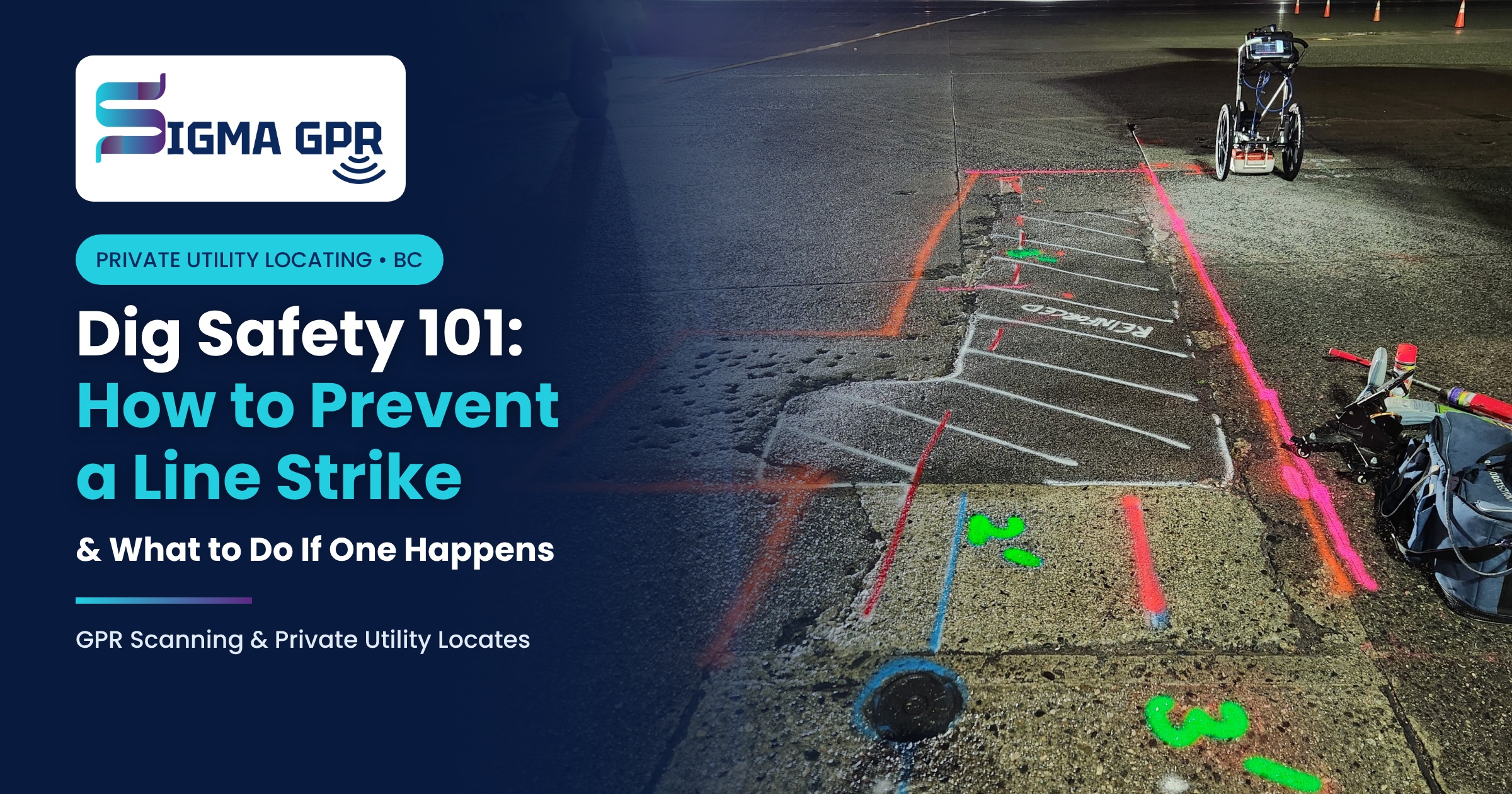

The best way to handle a line strike is to prevent one. Almost every strike can be traced back to a missed step before digging: no ticket, no private locate, faded marks or a bucket too close to a line.
This guide covers the simple habits that prevent a line strike on BC job sites, and the first steps every crew should know in case one ever happens.
Part 1: How to prevent a line strike
1. Submit a BC 1 Call request first. Do it at least three business days before you dig, and check that your ticket is still valid on the day. Our free BC 1 Call Reminders email you before the start deadline and the expiry.
2. Locate private lines too. BC 1 Call members mark their own lines, usually up to the property line or meter. Power to outbuildings, gas to heaters, irrigation and site lighting are often private and unmarked. Read BC 1 Call vs Private Utility Locating.
3. Mark your dig area in white. It shows locators exactly where to look, so nothing is missed at the edges.
4. Know what the marks mean. Red is power, yellow is gas, orange is telecom, blue is water, green is sewer. Brief every crew member before work starts.
5. Keep the marks visible. Rain, leaves and traffic wear paint away fast in BC. Photograph marks the same day and ask for a re-mark if anything fades. See Fall and Winter Utility Locates.
6. Hand dig or hydrovac near every mark. Machines should stay back from marked lines. Expose each line carefully before digging around it, following the utility owner’s instructions.
7. Stop when something doesn’t match. If you find a line that isn’t marked, or the marks don’t match what you see, stop and call before going further.
8. Scan before you core or cut concrete. Buried lines aren’t only in the ground. Conduits and post-tension cables run inside slabs too. See Concrete Scanning in BC: Why Every Core Needs a Scan.
Part 2: What to do if a line strike happens
Prevention works, but every crew should still know the first steps. Keep these posted in the site trailer and in every truck.
- Stop work. Shut off machinery and anything that could spark.
- Gas escaping or anyone hurt: move everyone away, upwind if you can, and keep people and vehicles back. Call 911 and the gas emergency line.
- Power line damaged or down: stay at least 10 metres away and call 911.
- Don’t repair, backfill or cover the damage, and don’t operate valves.
- Call the utility owner, even if the damage looks minor. A scraped coating or a nicked tracer wire still needs inspection.
- Take photos of the damage and the markings nearby, and write down the time.
Numbers to keep on hand
Who | Number |
|---|---|
Emergency | 911 |
FortisBC gas emergency | 1-800-663-9911 |
BC Hydro | 1-800-224-9376 |
BC 1 Call | 1-800-474-6886 |
WorkSafeBC | 1-888-621-7233 |
Gas line damage must also be reported to FortisBC and WorkSafeBC. For a quick reference on your phone, see our Emergency Steps page.
Make it part of every job
- Add a dig safety check to your pre-job meeting.
- Use our free Safety Checklist before every dig or core.
- Keep locate sheets, photos and notes together in a Site Log.
- Share this page with new crew members.
The best emergency plan is the one you never need
A few hours of locating and scanning before you dig is the simplest way to keep crews safe and jobs on schedule. Sigma GPR provides private utility locating and GPR scanning across Metro Vancouver, the Fraser Valley and the rest of BC.
Book a locate or call (778) 302-0868.