
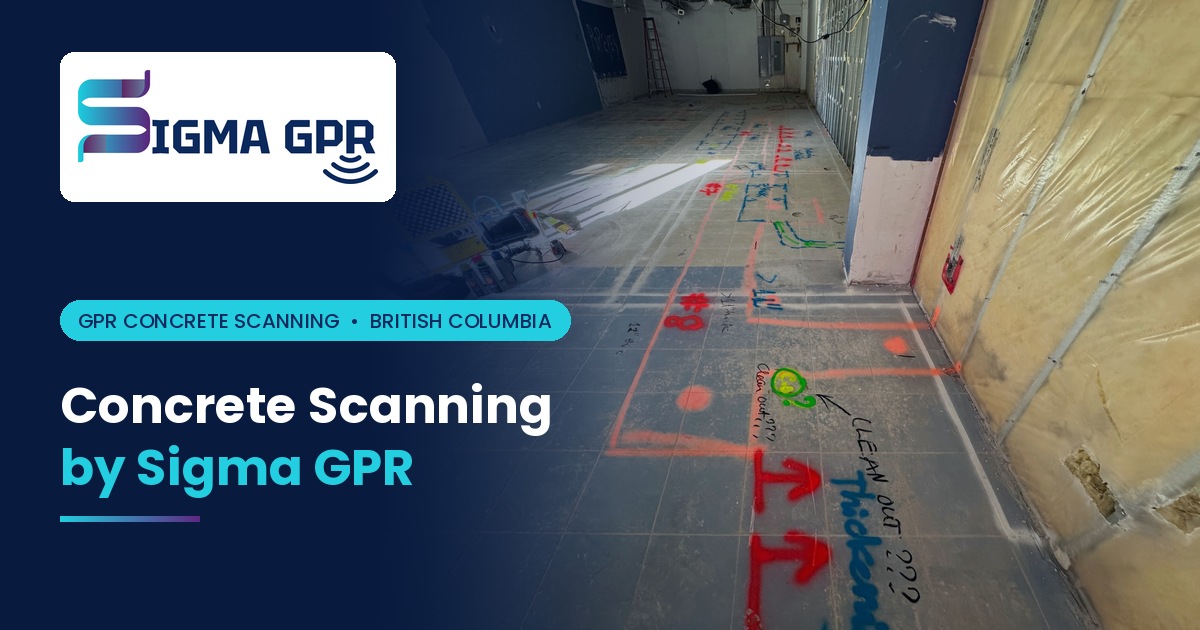
A concrete scan usually takes a few hours. Hitting a post-tension cable, a live conduit or a main structural bar can stop a job for days and bring in engineers, repair crews and insurers. That gap is why more BC contractors, property managers and engineers now treat scanning as a standard step, not an extra.
Here is what concrete scanning does, which projects need it, and what to expect when you book one.
What concrete scanning is
Concrete scanning uses ground penetrating radar (GPR) to see inside a slab, wall, beam or footing without damaging it. The scanner sends radio waves into the concrete and records what reflects back. A trained technician reads those signals on site and marks what is inside directly on the surface.
A scan can show:
- Rebar and wire mesh, including top and bottom layers
- Post-tension (PT) cables
- Electrical conduits and embedded services
- In-floor heating lines
- Voids and changes in slab thickness
For a closer look at what the results mean, see What a Concrete Scan Actually Tells You.
5 reasons scanning is essential
1. It protects your crew. Cutting into a live conduit can cause electrocution or an arc flash. A scan shows where conduits run so the crew can core around them.
2. It protects post-tension slabs. Parkades, podiums and high-rises across Metro Vancouver are often post-tensioned. A cut tendon can release with enormous force and weaken the slab. Read more in Post-Tension Slabs: Why You Should Never Cut Without Scanning First.
3. It keeps the structure sound. Cutting main reinforcing bars can reduce a slab’s capacity and lead to costly engineering reviews and repairs.
4. It keeps the schedule on track. One strike can mean a shutdown, an engineer’s visit and a repair before work can continue. A scan booked ahead avoids that.
5. It is often required. Many engineers, general contractors, property managers and strata councils ask for a scan before any coring or cutting is approved.
Projects that need a concrete scan
Project | What we usually look for |
|---|---|
Condo and office renovations | Conduits, PT cables, in-floor heating |
Parkades and podium slabs | Post-tension cables and rebar |
Commercial tenant improvements | Conduits and rebar before new plumbing or electrical |
Warehouses and industrial floors | Slab thickness and rebar before racking anchors and trenches |
Foundations, footings and pedestals | Rebar before dowels and anchor bolts |
Older buildings | Undocumented services and changes not on the drawings |
GPR or X-ray?
Both methods can see inside concrete, but GPR is the better fit for most BC job sites.
| GPR scanning | X-ray |
|---|---|---|
Radiation | None | Yes, the area must be cleared |
Access needed | One side of the slab | Both sides |
Results | Marked on site, same day | Film processed after the shot |
Disruption | Work continues nearby | Floors above and below cleared |
How to prepare for your scan
- Mark every planned core, cut or anchor location on the slab.
- Clear the area of tools, materials and debris.
- Share drawings or as-builts if you have them.
- Tell us if the slab is post-tensioned or if you are not sure.
- Have someone on site who can confirm the final locations.
For a quick pre-work list, use our free Safety Checklist.
What you get from Sigma GPR
- Every bar, cable and conduit marked on the concrete, with depths
- Clear safe zones for your cores, cuts and anchors
- A technician who explains the findings to your crew on site
- Service across BC, from Vancouver to Chilliwack, Kamloops, 100 Mile House and Kitimat
Frequently asked questions
How long does a concrete scan take? Most scans take one to a few hours, depending on the number of locations and site access.
How deep can GPR scan? It depends on the concrete and the equipment. Most slabs, walls and footings can be scanned through their working depth. Ask us about your specific slab.
Can you scan through tile or flooring? Often yes. Some coverings affect the results, so tell us what is on the surface when you book.
Do I need a scan for a single core? Yes. One core in the wrong spot can hit a PT cable or live conduit just as easily as ten.
Book your scan
Planning to core, cut or drill? Scan first. We usually quote within a couple of hours.
Book a scan or call (778) 302-0868.