
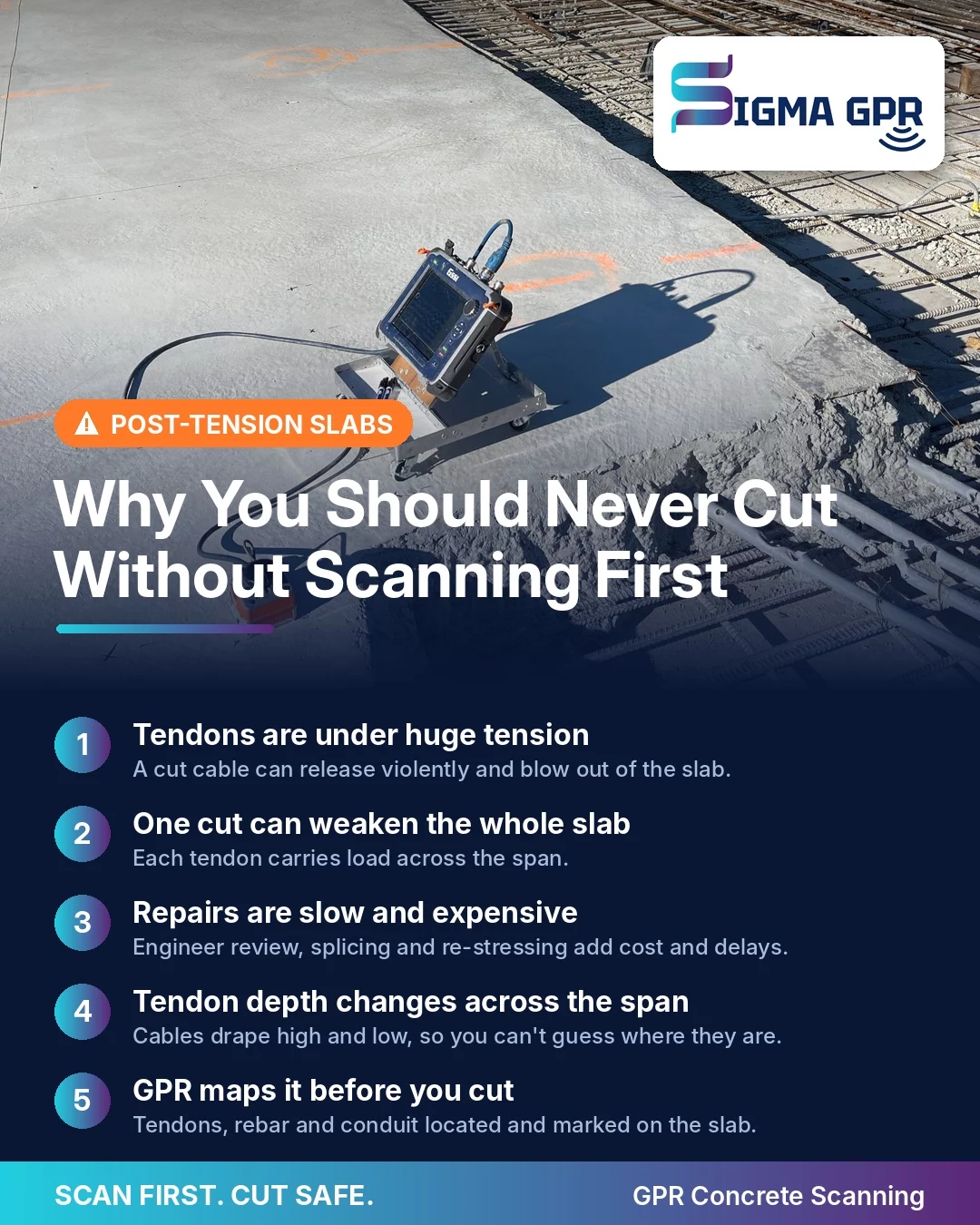
Of everything hidden inside a concrete slab, post-tension cables are the item you most want to know about before you cut, core, or drill. Hitting one is a serious safety risk, and it’s one of the most avoidable mistakes on a job site.
What post-tension cables are
Post-tension slabs are reinforced with steel cables that are pulled tight after the concrete is poured. That tension is part of what gives the slab its strength. It’s common in floors, parking structures, and other large concrete structures, and you can’t tell from the surface whether a slab has them or where they run.
Why hitting one is serious
Because the cables are under tension, damaging one is very different from cutting through ordinary rebar.
- Safety. A cut or damaged cable can put workers at serious risk.
- Structural impact. Damaged cables can affect the strength of the slab and the structure.
- Cost. Repairs can be complex and expensive, and work often has to stop while engineers get involved.
- Delays. A strike can shut down the area and the schedule.
Why drawings aren’t enough
Plans can show the general layout, but the exact position of cables in the finished slab can differ from the drawings. Renovations and earlier work may have changed things too. A scan shows what is in the slab today.
How a GPR scan helps
A technician scans the surface with Ground Penetrating Radar, which sends radar signals into the concrete and records what comes back. Post-tension cables, rebar, and conduits show up in the data. We then mark their positions on the surface, so your crew can see where it’s safe to cut and where it isn’t, and nothing is damaged to find out.
When to scan
- Before coring or drilling for pipes, anchors, or penetrations
- Before sawing openings in slabs
- During renovations and retrofits
- Whenever you don’t know how a slab was built
Tips for a safer job
- Scan first. Don’t assume a slab is free of cables.
- Tell your scanner what you’re planning. Share the type of work and where it will happen.
- Review the markings with the crew before work starts.
- Re-scan if the cut location changes, even slightly.
- Stop and ask if something unexpected shows up while you work.
The bottom line
A scan takes little time compared with the risk and cost of hitting a post-tension cable. At Sigma GPR Services Inc., we provide GPR concrete scanning across British Columbia, locating rebar, post-tension cables, and conduits before you cut.
Planning to cut, core, or drill in BC? Get in touch before you start.
 +1 (778) 302-0868
 [email protected]
 sigmagpr.com