
Beams and columns carry the loads that hold a building up. Drilling or coring into them without knowing what is inside is one of the costliest mistakes on a renovation or tenant improvement job.
A single hole through a main bar, a post-tensioned tendon or a live conduit can mean an engineer’s review, a structural repair, a power outage or a serious injury. Concrete scanning lets you see the reinforcement and embedded items first, so you can mark safe drilling locations before a bit ever touches the surface.
This guide explains what sits inside beams and columns, how scanning works, the steps a good scanning crew follows, and the mistakes to avoid.
What’s Inside a Concrete Beam or Column
Beams and columns are far more congested than a typical slab. Reinforcement is packed tightly because these members resist bending, shear and compression at the same time.
Element | Where it’s found | Why it matters when drilling |
|---|---|---|
Longitudinal (main) bars | Run the length of the beam or height of the column, usually near each face and corner | Cutting one reduces load capacity and often requires an engineer’s sign-off |
Stirrups and ties | Wrap around the main bars at regular spacing | Spacing is tight near supports, leaving less room to drill |
Post-tensioned (PT) tendons | Common in beams and slab bands in mid- and high-rise buildings | Tendons are under high tension; a strike can be dangerous and expensive to repair |
Conduits and pipes | Sometimes cast into beams or run alongside column faces | Live electrical lines create shock and outage risks |
Embedded plates and anchors | At connections, brackets and steel attachments | Can damage bits and indicate critical connections |
In beams, the heaviest steel usually sits at the bottom near midspan and at the top over supports. In columns, main bars sit close to every face, so there is rarely a “safe side” without scanning.
How Concrete Scanning Works
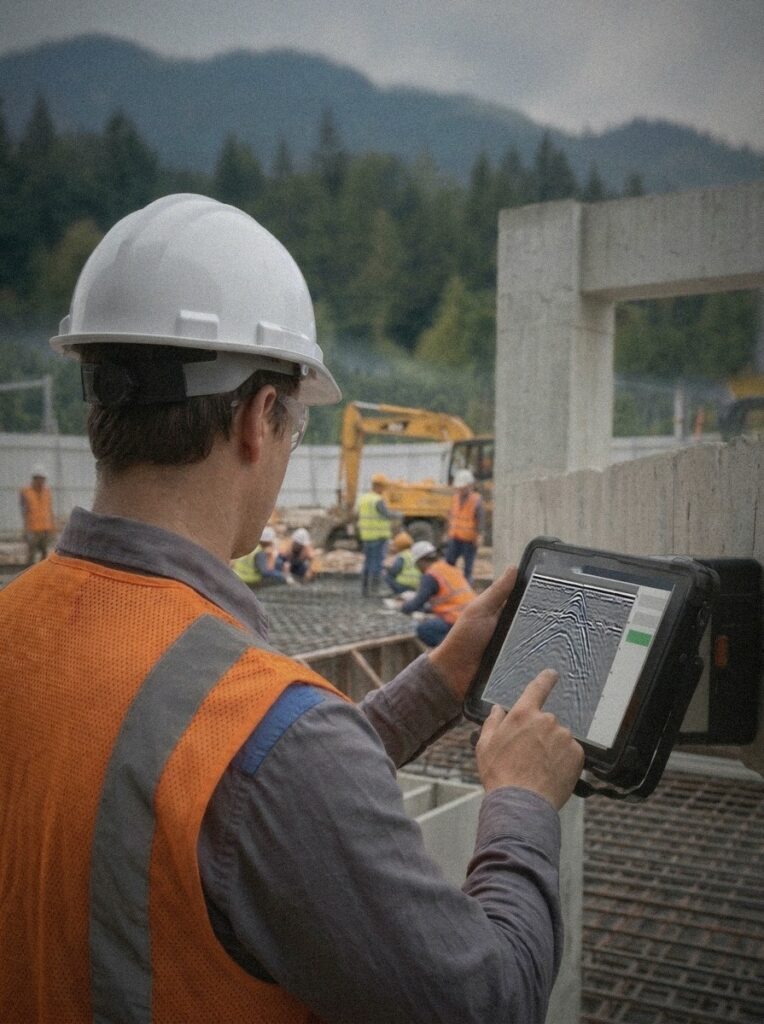
Most concrete scanning uses ground penetrating radar (GPR). The scanner sends short radio pulses into the concrete. When a pulse hits a material with different properties, such as steel, plastic conduit or an air void, part of the signal bounces back. The software turns those reflections into images showing the location and approximate depth of each target.
For structural concrete, technicians use high-frequency antennas that give sharp detail in the outer layers of the member, where most reinforcement sits.
What GPR does well
- Locates rebar, stirrups, ties and PT tendons
- Finds metallic and non-metallic conduits
- Estimates the depth of targets and the concrete cover
- Gives results on site, in real time, with no radiation hazard
Where GPR has limits
- Very dense steel can mask objects sitting behind the first layer
- Depth readings are estimates and depend on calibration and moisture
- Narrow columns and corners leave less room to move the scanner
- It cannot always tell whether a conduit is live
When GPR alone isn’t enough, an experienced crew may combine it with electromagnetic locators or, for critical cores, recommend X-ray imaging.
Step by Step: Scanning Beams and Columns Before Drilling
- Confirm the scope. Mark the proposed hole or core locations, sizes and depths. Share drawings, PT layouts or engineer notes if you have them.
- Prepare the surface. Remove loose debris, coatings or fixtures that block the scanner from sitting flat on the concrete.
- Scan in two directions. On a beam, the technician scans along its length to find stirrups and across its width to find main bars. On a column, each accessible face is scanned vertically and horizontally.
- Scan every face you will drill through. For through-holes, scanning the exit face helps confirm what lies near the back of the member.
- Map the findings on the surface. Rebar, tendons and conduits are marked directly on the concrete with paint or markers, usually color-coded by target type.
- Mark clear zones. The crew identifies safe drilling areas between targets, allowing extra clearance around PT tendons and live services.
- Document the results. A short report with photos, depths and marked locations gives the drilling crew and engineer a clear record.
- Drill as marked. If a bar is hit unexpectedly, stop and check with the engineer before continuing.
Common Mistakes to Avoid
- Relying on old drawings alone. As-built conditions often differ from the plans, especially in older Metro Vancouver buildings that have been renovated several times.
- Scanning only one face of a column. Bars sit near every face. A clear reading on one side says little about the others.
- Assuming beams have no PT. Many concrete buildings in BC use post-tensioned beams and slab bands. Always confirm before drilling.
- Drilling too close to the marks. Paint lines show the centre of a target, not its edge. Leave a safe offset.
- Moving the hole after the scan. If the location shifts, the new spot needs to be scanned too.
- Skipping the engineer. Any hole that may cut reinforcement in a beam or column should be reviewed by the structural engineer of record.
Frequently Asked Questions
Do I need to scan before drilling small anchor holes in a beam or column? Yes. Even small holes can strike a main bar, tendon or conduit. Scanning is quick and costs far less than a repair.
Is GPR concrete scanning safe for people on site? Yes. GPR uses low-power radio waves and gives off no ionizing radiation, so work nearby can continue during the scan.
Can you scan a column from one side? Sometimes, but results are best when every face that will be drilled is accessible. Your technician will advise on site.
How long does it take to scan a beam or column? It depends on the number of locations and access. Most single-location scans take minutes, and markings are done the same visit.
What should I have ready before the scan? Marked hole locations, clear access to all faces, any available drawings, and a lift or ladder for overhead beams.
Scan Before You Drill with Sigma GPR
Sigma GPR Services Inc. provides concrete scanning across Metro Vancouver and British Columbia. Our technicians locate rebar, post-tension cables and conduits in beams, columns, slabs and walls, then mark safe drilling zones directly on the concrete.
Planning to core or drill into a structural member? Book a scan or call (778) 302-0868.