
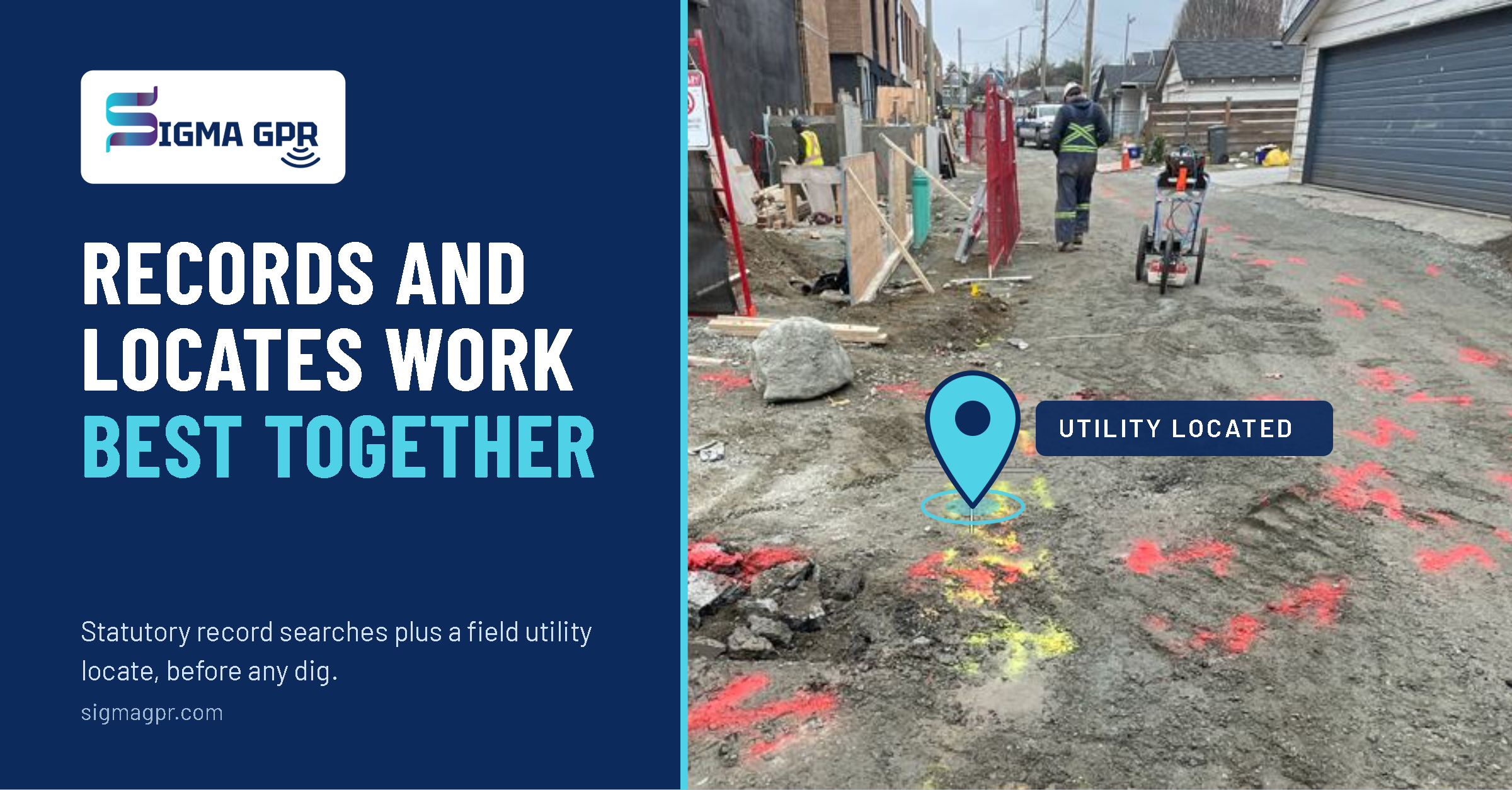
Every dig starts with a question: what’s under here? Most teams answer it with records, and records are a good start. But records show where a line was planned or recorded. They don’t always show where it ended up. That gap is where most strikes happen.
The five lines under most job sites
Whatever the site, these are the services we map most often:
- Gas. A strike is a serious safety risk to your crew and everyone nearby.
- Water. A break can flood the excavation, damage property, and cut service.
- Telecommunications. Cut cable or fibre can take out phone and internet for a whole area.
- Electrical. A strike can cause serious injury as well as outages and equipment damage.
- Drainage. Damaged lines lead to leaks, collapses, and expensive repairs.
They often run close together and cross each other, so knowing where one is doesn’t tell you where the next one is.
Step 1: Start with the records
A statutory record search checks what utility owners have on file about their lines. It tells you which services to expect and gives you a plan before anyone sets foot on site. It’s the right first step, and it shapes what the locate needs to look for.
Step 2: Confirm it in the field
Records can be out of date, incomplete, or simply off. Lines get repaired, rerouted, or added over the years, and not every change makes it back into the file. A field locate uses the latest GPR technology and tracing methods to find what’s physically in the ground, then marks it on the surface so everyone can see it.
Think of it this way: the records are the forecast, and the locate is looking out the window.
What can go wrong if you skip a step
- Skip the records, and you may not know a service is there to look for.
- Skip the locate, and you’re relying on information that may not match the ground.
- Skip both, and you’re digging blind.
The consequences are the same in every case: injury risk, service outages, repair costs and liability, delays while lines are repaired and cleared, and damage to your reputation with clients and utility owners.
What a good locate gives your crew
- Clear surface markings showing where lines run
- A shared picture of the site that everyone on the crew can see
- Confidence to start digging, and to dig carefully near the marks
Treat markings as a guide, keep them visible, and ask for a re-locate if the work area changes or the marks fade.
The bottom line
Records and locating answer two different questions, and a safe dig needs both answers. At Sigma GPR Services Inc., we locate, identify, and map gas, water, telecommunications, electrical, and drainage lines across British Columbia, and we offer statutory record searches too.
Planning a dig in BC? Get in touch before you start.
 +1 (778) 302-0868
 [email protected]
 sigmagpr.com