
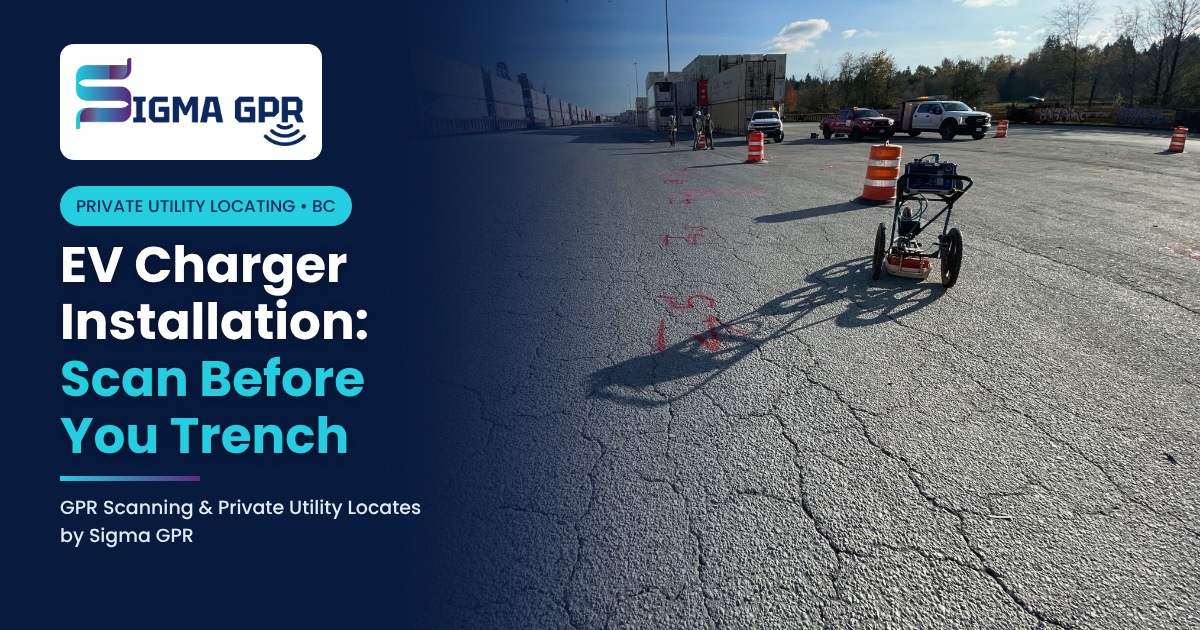
EV charger installation looks simple on the drawings: a panel, a charger and a run of conduit between them. In practice, that conduit often goes through a concrete slab or under a driveway, lawn or parking lot. That is where crews hit buried power lines, gas services, irrigation, post-tension cables and rebar.
Across BC, more homes, strata buildings and businesses are adding chargers every year. Here is where the risks are on each type of install, and how a quick scan before you trench or core keeps the job on schedule.
Where EV charger installs go wrong
|
Install type |
Typical work |
What can be hit |
|---|---|---|
|
Parkade or underground garage |
Coring through slabs and walls, anchoring pedestals |
Post-tension cables, rebar, conduits |
|
Strata and condo buildings |
Long conduit runs, cores between levels |
PT cables, existing electrical and telecom |
|
House driveway or yard |
Trench from the house or panel to the charger |
Power to garages, gas lines, irrigation, telecom |
|
Commercial parking lot |
Trenching across asphalt, new bases for chargers |
Site lighting, storm drains, water, fibre |
|
Fleet depots and workplaces |
Multiple chargers, duct banks, transformer pads |
Existing feeds, storm and sanitary lines |
Parkades and strata buildings: scan before you core
Many parkades and podium slabs in Metro Vancouver are post-tensioned. A core through a PT tendon can release it with enormous force and weaken the slab. Even in conventional slabs, cutting main rebar or a live conduit causes delays, engineering reviews and repairs.
A GPR concrete scan maps rebar, PT cables and conduits around every core and anchor location. We mark them on the slab so your crew knows exactly where it is safe to drill. Read more in Post-Tension Slabs: Why You Should Never Cut Without Scanning First.
Driveways and yards: locate before you trench
The trench from the panel to the charger often crosses lines nobody remembers: power to a detached garage, gas to a BBQ or heater, irrigation, yard lights and internet cables.
BC 1 Call members mark only their own lines, usually up to the meter or property line. Private lines on the owner’s side are not marked. A private utility locate finds and paints them before the trench goes in. See BC 1 Call vs Private Utility Locating.
Parking lots and commercial sites
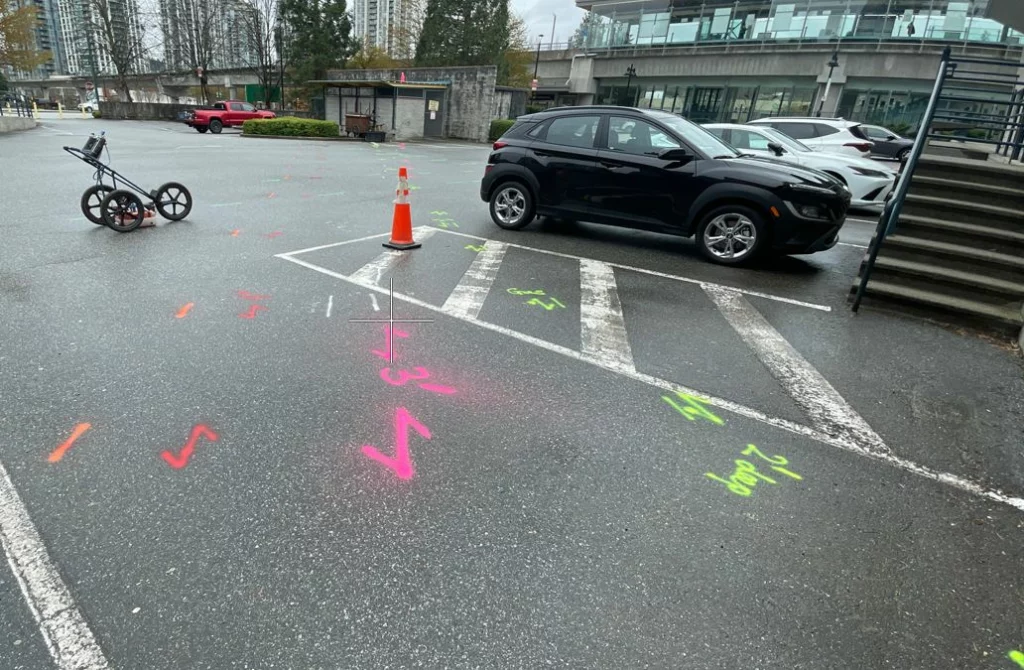
Commercial lots usually have the most buried services and the least reliable drawings. Lighting circuits, storm drains, water lines and fibre often run right where new chargers are planned. Scanning the whole trench path, not just the charger locations, avoids surprises halfway through the job.
A simple process for every install
- Plan the charger locations and conduit route.
- Mark the route and core locations on site: white paint outdoors, tape or marker indoors.
- Submit a BC 1 Call request for outdoor digging.
- Book a concrete scan for cores and anchors, and a private locate for trenches.
- Adjust the route around anything marked.
- Hand dig or hydrovac near every marked line.
- Photograph the markings for the job file and the strata or owner records.
Why it pays off
- Fewer change orders. Finding a conflict before the trench is cheaper than rerouting after.
- Safer crews. No surprise contact with live power or gas.
- Happier clients. Strata councils and property managers expect a clean, on-time install.
- Better records. Scan photos show the building owner what is in the slab for future work.
Frequently asked questions
Do I need a scan for one charger in a parkade? Yes, if you are coring or anchoring into the slab. One core in the wrong spot can hit a PT cable.
Can you scan the whole conduit route at once? Yes. Booking one visit for every core, anchor and trench on the project is the fastest and most cost-effective option.
How long does it take? Most residential and small parkade jobs take one to a few hours. See How Long Does a GPR Scan Take?
Book a scan for your EV charger project
Sigma GPR provides concrete scanning and private utility locating for EV charger installations across Metro Vancouver, the Fraser Valley and the rest of BC.
Book a scan or call (778) 302-0868.